Monday, 6 January 2014

Mise-En-Scene For School's Out

This is what our protagonist wore:
film poster


We chose this because we thought it reflected her character and we took inspiration for her costume from Pretty In Pink (1986)

We liked the film as it wasn't a conventional rom-
com but had a love triangle between the 3 characters.

-----> this is what she wore in pretty in pink


We also used inspiration from pretty in pink for the other protagonist. He wore this: --->


which we took inspiration from this --->


Tuesday, 24 December 2013

CW: Narratives In Party Off


Our film, Party Off!, is a romantic comedy it takes inspiration from many different romantic comedies, including Love Actually and Bridget Jones: Edge of Reason. We have taken guidance from both these films and also from the narrative theories that we have looked at; throughout our film and its opening these narrative themes will be set up.


Narrative Enigma:


In our film we plan to use narrative enigma. We hope to be able to keep the look of the main character a secret. In order to do this, but still make sure it is clear that she is the main character we will have her voice first, as the voice over. When we do introduce her we will show her coming back up after clearly being sick, we plan to have her look as unglamorous as we can, by having her cry before hand and have her mascara running, to make this obvious.


This choice was made after reflecting upon the opening sequence of Bridget Jones: Edge of Reason. In this one of the early shots of Bridget, who has previously been set up as the main character, is of her about to jump out of a plane. We thought through what the director was creating with this shot and figured that it was to establish some form of relate-ability between the character and the audience, the fact that Bridget is no seen as glamorous all the time makes her, as a character, more relatable.

Todorov’s Structure:


We will follow Todorov’s narrative structure, but not strictly. We will create the starting equilibrium through the scrapbook, showing the happy times before the start of the film and, through the scrapbook, we will move towards the disequilibrium. By having a pre-established equilibrium that is only touched upon through the starting sequence we are somewhat mirroring Love Actually. The characters in Love Actually have a back story proceeding the events of the start of the movie; we pick this up through the start of the opening and throughout the film. By having the equilibrium pre-established we save time in the opening, meaning we can include more content within it.


Propp’s Archetypes:


We do not have many of Propp’s character archetypes. This is because, throughout the examples we have looked at and through our research we have not seen many examples where a Romantic Comedy contained these characters.


The link that we have been able to make, however, to Propp’s archetypes is between the main character, which we have seen is comparable to the hero, mainly because they commonly get the prize/prince/princess. We have also found a comparison to the villain, a commonly occurring character that often tries to steal the prize, they are also somewhat comparable to the false hero. Finally, we have found links to the helper, we originally thought that they could be the friends. We have not been able to find links to the donor or dispatcher.


Binary Opposition:


The most common and obvious binary opposition that we have seen is between the main character and their love interest. In all our examples and almost all Romantic Comedies the two are male and female. There are not many other binaries that we have noticed.
In our film, we plan to also have the binary opposition between the love interest and the main character. We have also made a binary opposition between the main character and her friend. The friend will be a popular, sporty and a stereotypical cheerleader type person whereas the main character will be unpopular, dorky and stereotypically nerdy. This will create conflict, naturally, later on in the film.

Friday, 20 December 2013

Who Would Watch A Rom Com?

Conventionally we are targeting a teen audience as this is where most Rom-Coms are aimed at, however we also noticed from further research that they are also targeted at people who are in a long term relationship or marriage which reduces the chances of it being a teen audience therefore it is good to target a secondary audience that being 24-35.


However we think it is wiser to stick to a target audience we can relate to and know what they like than be adventurous and not produce a film that is as good.


For this we think our idea we need to aim at a teenage market at someone who may enjoy things like Wild Child, however we also think it is important to remember our indie background so it is important not to over aspire therefore we looked Submarine to take ideas from that and look at a film that was digitally produced. 

Wednesday, 18 December 2013

Final Cut Pro X (PT3)


Since my last post on Final Cut Pro we have learnt how to make our clips more organised so they are not all spread out where they can become lost and become untidy. Therefore we were shown on final cut how to make tags onto our clips to make them easier to find as they would become catergorised and therefore organised. We made the tags in accordance to where we had filmed them and the characters that were in the scenes. 
we also learnt how to layer things below using clips so you get the same sound but the clip cant be seen which can be very useful if you cant record the sound of your own that you want or you cant import one from the library on final cut but you do have a sound of your own that you like but its the wrong clip for the scene. 


 we also learnt how to layer things like what you can see in the shot here. ----->


Sound: Key Conventions Observed So Far....


Whilst researching films for my genre (Rom-Com). we started to notice a recurring in the music chosen.

The music usually has a pop theme or contains some sort of wind instrument, percussion like a piano with a guitar or other string instrument. which fits nicely with the happy theme that usually runs with a rom com film.

Monday, 16 December 2013

Target Audience Research


The Guardian 

This article shows that although rom coms often get thrashed by the critics the audience still enjoyed them, we felt this was important.
It's also the latest in a long line of contemporary romantic comedies – proving that no matter how progressive we imagine we have become, our dating aspirations remain rooted in centuries-old tradition.


The Guardian

This shows that Rom-Coms are popular with couples especially around valentines day. But now this is changing.
Reviews were scathing, but ensemble romcom Valentine's Day has finally ended. 


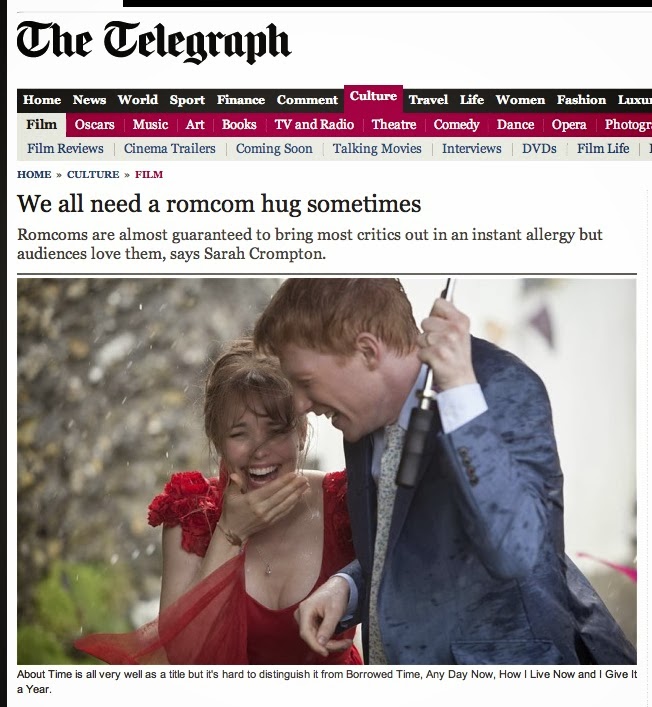
Telegraph


Although critics complain sometimes there is nothing better than watching a rom-com. Although the formula is the same and can become repetitive and this is what the critics don't like, however for some people its the best thing - this is the audience we want to target.
I think it is this sense of how comforting movies can be that critics sometimes miss. 


Watching About Time is like being given a big hug, and it is a very nice sensation. 

Marley + Me ( a romantic comedy where everyone is in love with the dog) can reduce me to a helpless happy blubber, and every time Notting Hill is on television (which is surprisingly often) I find myself compelled to watch it, and even mire compelled to sob at the "I'm just a girl standing in front of a boy, asking him to love her" line. I know its corny, but it doesn't matter. It works its magic every time.

Romcoms tend to defy such rigorous critique.


Richard Curtis is the Mrs Miniver of our times, though rather wittier. His films fulfil the same function of making Britain seem a good place, full of nice people.  


Romantic comedies seem to take over where the fairytales of childhood left off, feeding our dreams of a soulmate;

Now, hot on the heels of It's Complicated, Crazy, Stupid, Love offers further proof that the romcom, rather than desert we middle-lifers, has decided to mature with us. In the US, 64% of the opening weekend audience was female and 71% were over 25. Not that our aspirations have changed much, judging by this script. We still want our hero and heroine to convince us that a stroll into the sunset and beyond is the most likely outcome of initial adversity.

And it is still heroes and heroines we're talking about; despite homosexuality long ago entering the cultural mainstream, a single-sex relationship has yet to be the full focus of a mainstream romance, unless you count Brokeback Mountain where, I believe, the comedy was unintentional; or Mel Gibson and Danny DeVito. "When Harry Met Henry" and "When Sally Met Sarah" are long overdue, and this only confirms how conventional the rules of engagement are when it comes to the romantic comedy genre. Today's cinema audience may be more cynical (and sexually active) than that of our parents but they still demand that verbal foreplay lead to physical consummation, and misunderstandings to love with a capital L. In the world of the romantic comedy, life hasn't changed much since the 1950s.

Ironically for a movie category not renowned for its originality or inventiveness, it's the one arena where women have been allowed to be feisty way before feminism made it de rigueur.

Since so many romantic comedies vary little in their storyline, the success or failure of such movies depends largely on whether we believe in the relationship of the protagonists.


Back in the good old days, all a Hollywood studio had to do to make tens of millions of dollars was release a film about a plucky, satisfyingly flawed female protagonist who finds quirky but ultimately bland love with a chesty yet tender-hearted man. Meet-cute, But I Can't Stand Him montage, scene where Everything Changes, infatuation montage, misunderstanding that threatens to derail the whole thing, dramatic gesture to correct misunderstanding, satisfying resolution. Boom. A Rom Com. But over the last few years, box office receipts have been disappointing. Hollywood execs say that audiences are sick of romantic comedy tropes, that the formula is tired. But women aren't tired of the romantic comedy formula at all; what we're tired of is films made by people who don't understand what female viewers want. And we've finally got other options.
The problem isn't that audiences are bored or that technology ruined everything; the problem is that there aren't enough people in Hollywood who understand why women watch romantic comedies making movies — there aren't enough women. Last year, only 18% of directors, writers, executive producers, producers, cinematographers, and editors working on the top 250 grossing box office films were women, a 1% increase since 1998. That's fucking embarrassing. And women want to watch movies; the god-awful Twilight franchise has grossed over a billion dollars, a mostly-female audience is nerding the fuck out on The Hunger Games. Brave, Les Miserables, and Silver Linings Playbook kicked ass in the 2012 box office. There's a gigantic opportunity to snag more female viewers by simply releasing a halfway decent romcom that doesn't depict women as psychopathic brides.
The romantic comedy is very much alive. It just needs to be made by people who understand why the romantic comedy audience watches. Romantic comedies need to be made by ... women. And with an ever-growing class of talented and funny female comedy writers currently working in TV, maybe the next architect of the romantic comedy of Hollywood's dreams has been right in front of it this whole time. If they'd only notice.
Millions of girls turn 13 ever year. Even if people discarded film genres once they caught onto their tropes, studio execs could figure that they've got at least 3 solid years of earnest romcom viewing from most young women before they catch on to the fact that every film is the same.